
In the competitive aftermath of airline deregulation in the United States, the 1980s saw an explosion of new low-fare carriers seeking to carve out niche networks from major hubs. Among these was Florida Express, a small but spirited jet airline based in Orlando that briefly operated in the eastern U.S. from 1984 to 1988.
Origins and Strategy
Known as “Flex” by the carrier’s employees, Florida Express was incorporated in Delaware on January 24, 1983, after an investment of $10 million by International Metals Machines, Incorporated, based in Des Moines, Iowa. It received its economic authority from the U.S. Civil Aeronautics Board exactly one year later. Under the leadership of Gordon Linkon, a seasoned industry executive with prior stints at Midway Airlines and Frontier Airlines, Florida Express commenced scheduled flights on January 26, 1984. Flight 101 took off from its hub at Orlando International Airport (MCO) to Norfolk, Virginia, using a British Aircraft Corporation (BAC) One-Eleven (N1544), dubbed by the airline as ‘Fastback Jets.’
Linkon’s plan was simple: create a regional, low-fare airline with a point-to-point route philosophy, focusing on underserved city pairs within Florida and the Mid-Atlantic and Southeastern United States. Its slogan and branding played up the promise of “Sunshine Skies,” aiming to connect travellers to Florida’s booming leisure market without the high fares associated with legacy carriers.
The fledgling carrier set up its headquarters at the airport-adjacent Orlando Tradeport, operating from a refurbished former military building. Confident in its long-term prospects, the airline secured a 27-year lease for terminal facilities at Orlando International Airport, a commitment that reflected its ambitious outlook. Annual costs for rental space and projected landing fees were expected to exceed $1 million.
From the outset, operational efficiency became a defining characteristic of the airline. Flightcrew and cabin staff frequently undertook additional duties beyond their flying schedules, assisting with reservations, answering telephones and selling tickets during quieter periods, an all-hands-on-deck approach that helped keep costs tightly controlled.
Within its first six months of operations, the airline had carried over 100,000 passengers. Linkon’s approach, offering frequent, low-fare non-stop services from Orlando to medium-sized cities, was proving highly effective. While established competitors such as Piedmont and Eastern served many of the same markets, their routings often included multiple intermediate stops or even aircraft changes en route, giving Florida Express a clear advantage in simplicity and journey time.
Fleet and Operations
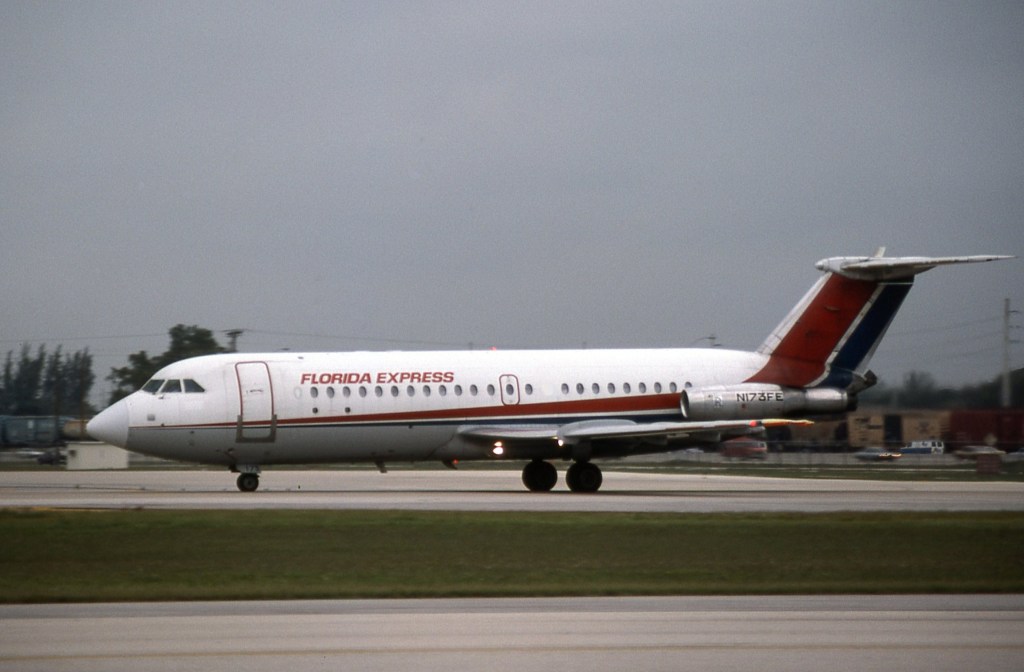
Florida Express’s fleet was distinctive. Unlike many startup carriers that opted for more common Boeing or McDonnell Douglas jets, Florida Express chose an all-British Aircraft Corporation BAC One-Eleven fleet. The airline ultimately operated 19 BAC One-Eleven jets, including Series 201AC, 203AE, and 401AK variants.
The BAC One-Eleven, a compact 80–100-seat short-haul jet, was well-suited to the airline’s network of relatively short sectors. Many of the aircraft had interesting pedigrees, arriving from a range of previous operators, including British United, USAir, and others, giving the fleet a distinctive mix of airframes.
Network and Expansion
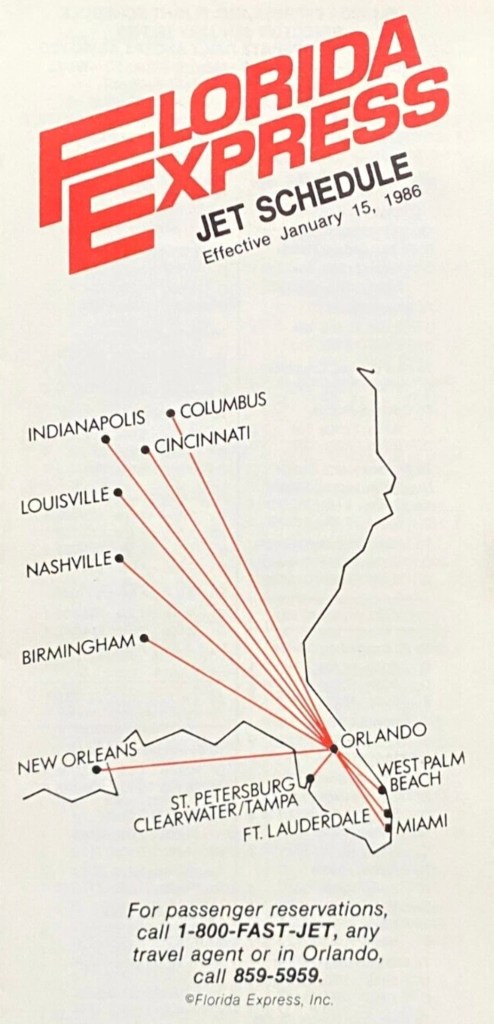
Initial nonstop services from its Orlando base included Indianapolis, Nashville, Norfolk, Ft Lauderdale, Miami, and Tampa, while one-stop services to Louisville and Richmond were also operated. Throughout the mid-1980s, Florida Express steadily expanded its route map. By 1987, the airline served a variety of destinations from Orlando, including Ft Lauderdale and Tampa/St. Petersburg. Petersburg, Sarasota/Bradenton, Louisville, and even Nassau, Bahamas, reflecting its ambition to blend leisure and business routes.
This incremental growth came alongside a successful initial public offering in October 1985, which raised approximately $13 million in capital and helped finance network and capacity expansion.
Acquisition and Legacy
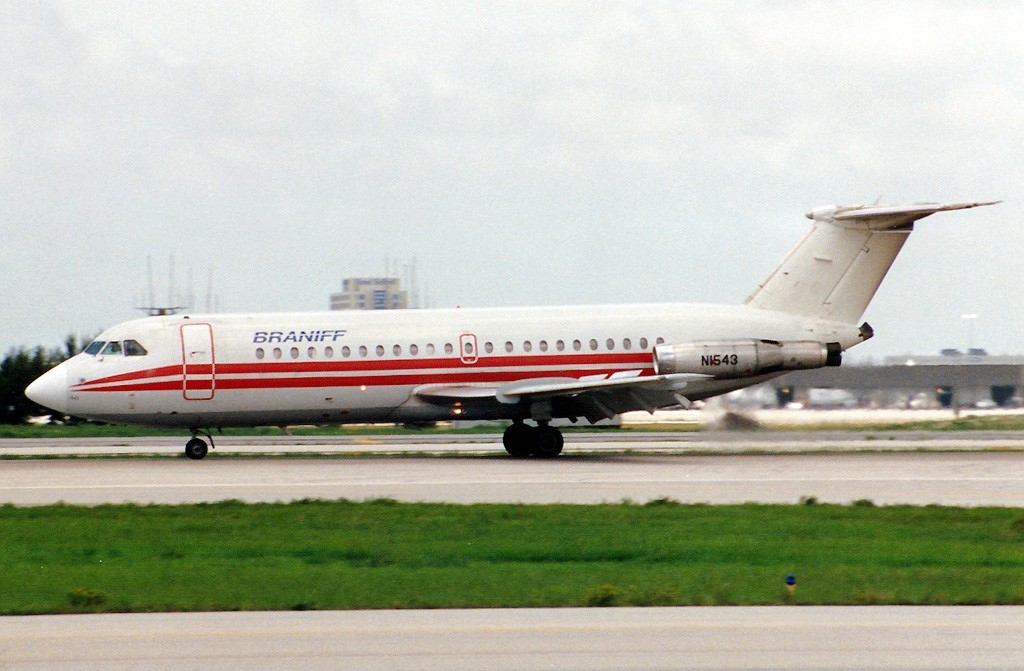
In October 1987, the newly revived Braniff, Inc., itself undertaking an aggressive expansion campaign, announced a bid to acquire Florida Express. The acquisition, valued at about $20 million, would add an established regional network and a robust operation at Orlando to Braniff’s expanding route map.
Before formal merger approval, Florida Express aircraft began flying under the Braniff Express banner from January 15, 1988, effectively serving as a feeder operation into Braniff’s broader system. On April 19 1988, the merger was finalised, and Florida Express ceased to operate as an independent airline; its aircraft and routes were fully integrated into Braniff’s operations.
Though its independent existence lasted only four years, Florida Express represents a fascinating chapter of U.S. airline history: a bold low-fare startup that capitalised on deregulation, stood out with an unusual fleet choice, and drew enough industry interest to be absorbed into one of the most iconic airline brands of its era.
Cover photo credit: Pete Macklin, CC BY 2.0, via Wikimedia Commons
© Jet Back In Time by Lee Cross
 Jet Back In Time
.jpg)

.jpg)