
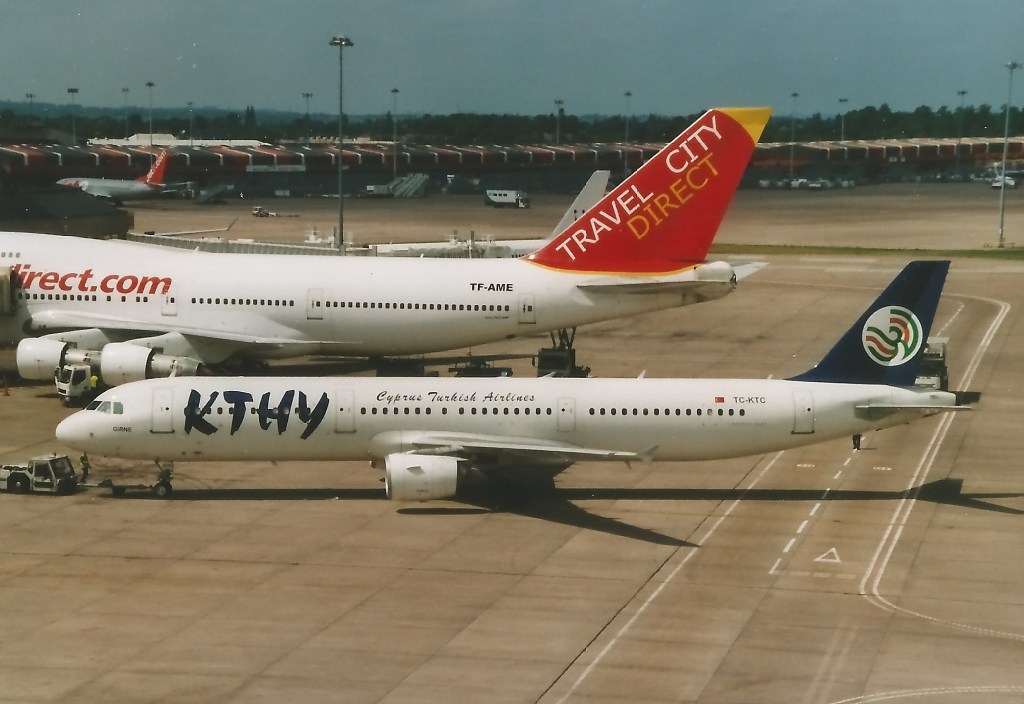
For 36 years, Cyprus Turkish Airlines — universally known by its Turkish name Kıbrıs Türk Hava Yolları (KTHY) — provided the principal air bridge between Northern Cyprus and the outside world. More than just an airline, KTHY became a symbol of connectivity for the Turkish Cypriot community, operating under political, legal, and commercial constraints unlike those faced by almost any other European carrier.
Its history is one of adaptation and survival, marked by an eclectic fleet, a network shaped by geopolitics rather than purely market logic, and a constant struggle to balance public expectations with financial realities. Ultimately, those pressures proved insurmountable.
Origins: An Airline Born of Necessity
KTHY was founded on December 4, 1974, only months after the division of Cyprus. The political rupture left Northern Cyprus isolated, with limited access to international transport and an urgent requirement for reliable air services, particularly to Turkey. The airline was established with joint ownership involving Turkish Airlines and Turkish Cypriot interests, reflecting both commercial intent and strategic necessity.
From the outset, KTHY’s mission went beyond profit. It was expected to guarantee essential connectivity for residents, students, workers, and the diaspora, even when routes or schedules made little economic sense. This quasi–public service role would define the airline for decades to come.
Ercan Airport and Operational Constraints
KTHY’s home base at Ercan Airport presented immediate challenges. In the mid-1970s, infrastructure was limited and operational margins were tight. Aircraft choice was dictated less by fleet strategy than by what could safely operate from the runway available.
Compounding these physical constraints were political realities. Because Northern Cyprus is not internationally recognised, direct international flights were (and remain) highly restricted. In practice, this meant that most services to Europe had to operate via Turkey, even when the final destination was geographically closer to Cyprus than to Anatolia. This enforced routing increased journey times and operating costs and reduced competitiveness relative to airlines operating nonstop from internationally recognised airports.

Early operations and the first jets
KTHY’s first commercial flight took place on February 3, 1975, using a Fokker F28 leased from Turkish Airlines on a routing from Istanbul via Ankara to Ercan. The F28’s robust performance made it well-suited to Ercan’s limitations and set the tone for a pragmatic early fleet philosophy.
One of the more unusual chapters in KTHY’s early years involved a pair of Boeing 720s (N733T and N321E), operated for a period with foreign flight crew and Turkish Cypriot cabin staff. Maintained overseas, the aircraft underlined the improvisational nature of early operations in a politically constrained environment.
Throughout its history, KTHY’s fleet reflected availability and affordability as much as strategic planning. The airline operated a wide variety of aircraft types, often for relatively short periods:
- Douglas DC-9-32 (TC-JAE) entered service in 1979 on lease from Turkish Airlines.
- BAe RJ100, operated briefly in the mid-1990s
- Tupolev Tu-154M, introduced in 1995 during a period of capacity experimentation
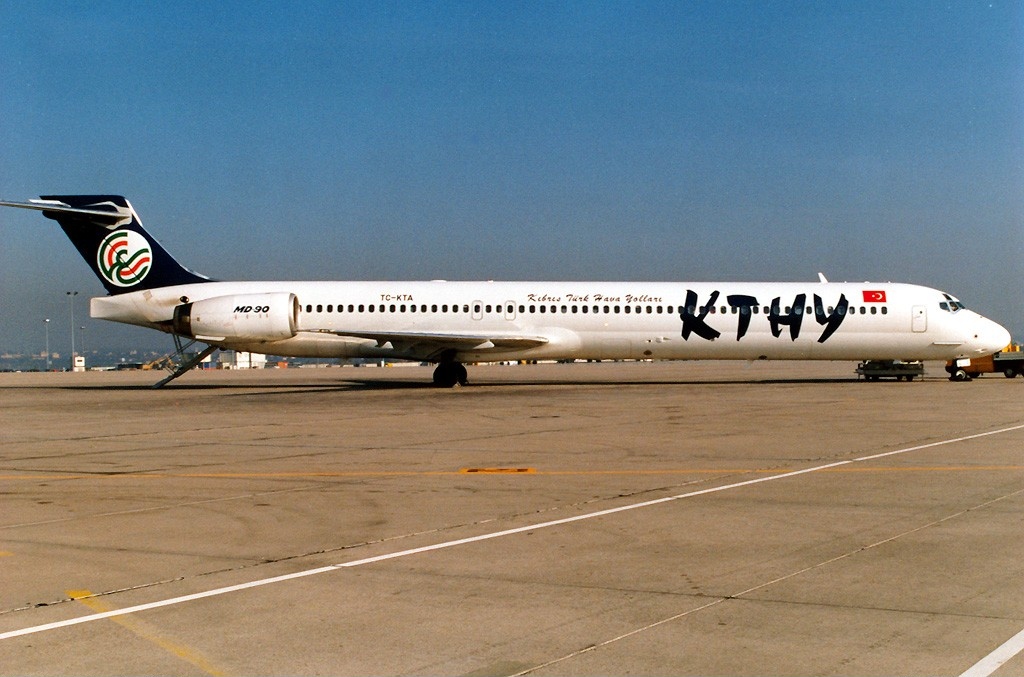
- McDonnell Douglas MD-81, MD-82, and MD-90, mostly on short-term leases
While this diversity afforded flexibility, it also imposed substantial costs on training, maintenance, and logistics, a burden for a small carrier with limited economies of scale.
The Boeing and Airbus Years
During the 1990s, KTHY turned to the Boeing 727-200 to provide higher-capacity lift on trunk routes. Several aircraft were operated between roughly 1990 and 2000, offering strong performance but at the cost of high fuel consumption and maintenance complexity.
As the decade progressed and newer-generation narrowbodies became widely available, the economics of operating classic trijets became increasingly difficult to justify.
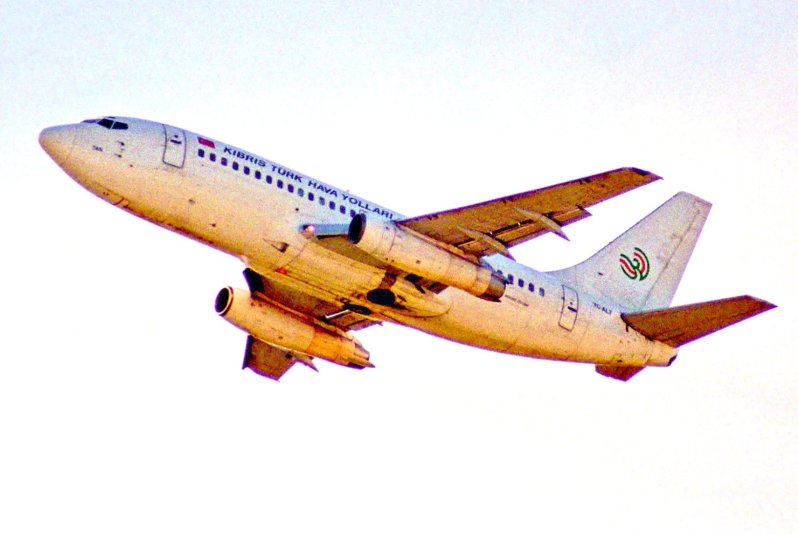
After a brief flirtation with the Boeing 737-200, the airline selected the Boeing 737-800, the first of which it received in 2000. It remained the backbone of the fleet until 2010. These aircraft were well-suited to KTHY’s needs, offering improved fuel efficiency and range for Turkey-based operations and onward European services.
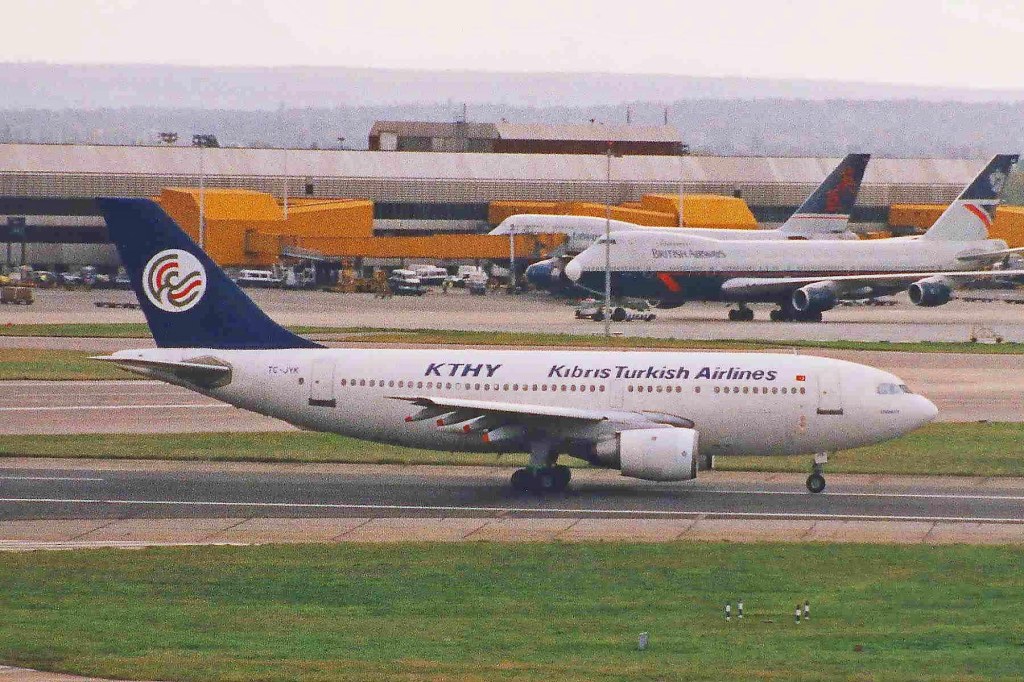
KTHY also operated several Airbus aircraft types over the years, the first being the A310-200/300 series. These were introduced in 1994 and proved successful, being popular with passengers and capable of carrying large amounts of cargo in their belly holds. They remained in the fleet for almost a decade, used on higher-demand routes and longer sectors.
It also operated several A320 Family aircraft, including A320s and A321s, the latter of which joined in February 2004 on lease from GE Capital Aviation Services. The type would become the key high-density workhorses.
Network and Commercial Reality
KTHY’s route network focused on frequent services to major Turkish cities, with onward connections to the UK and parts of Europe, catering to leisure traffic and the Turkish Cypriot diaspora. However, the enforced routing via Turkey diluted the airline’s competitiveness and increased costs relative to nonstop alternatives from southern Cyprus.
Seasonality further complicated matters. Summer demand could be strong, but winter loads were thin, leaving aircraft underutilised while lease and staffing costs remained fixed.
By 2010, KTHY’s financial position had become untenable. Losses were reportedly running at several million US dollars per month, with accumulated debts estimated at around $120 million.
On June 21, 2010, Turkish aviation authorities ordered the airline’s fleet grounded due to unpaid debts. Flights ceased overnight, stranding passengers and marking the abrupt end of operations.
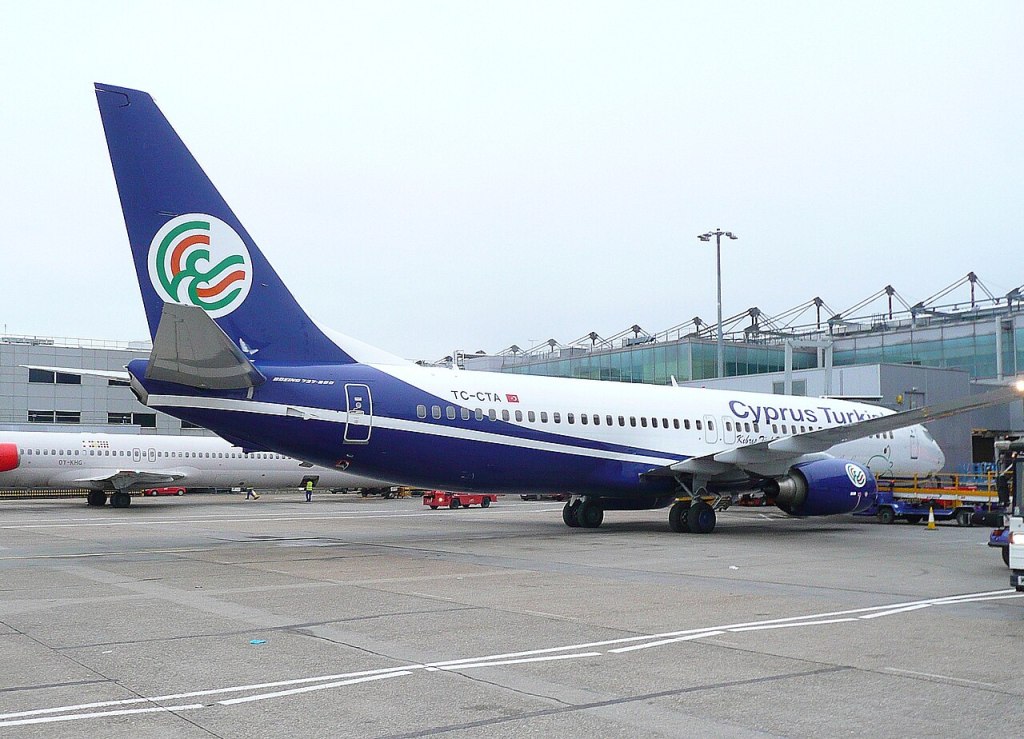
Attempts to rescue the airline through a sale, particularly to Turkish carrier Atlasjet, collapsed amid political tensions, labour opposition, and the sheer scale of KTHY’s liabilities. Later that year, the airline was formally declared bankrupt.
Cyprus Turkish Airlines was far more than a small regional carrier. It was a lifeline, a national symbol, and a daily presence in the lives of Turkish Cypriots for more than three decades. Its history illustrates how aviation can be shaped as much by politics and geography as by market forces.
When KTHY’s final flights touched down in June 2010, they closed a chapter that had begun amid uncertainty in 1974. The airline’s story remains a compelling case study in resilience, and in the limits of what resilience alone can achieve in commercial aviation.
Cover image credit: simon butler, CC BY 2.0, via Wikimedia Commons.
© Jet Back In Time by Lee Cross
 Jet Back In Time
.jpg)
.jpg)
.jpg)

.jpg)
.jpg)
