
In the crowded story of 1980s British independent airlines, London European Airways (LEA) stands out as a short, sharp experiment. Its brief story, from Vickers Viscounts to BAC One-Elevens, from “London European” to Ryanair Europe and back again, offers a revealing snapshot of how regulated bilaterals, licensing politics, and thinly capitalised start-ups could collide in the pre-European “open skies” aviation landscape.
London European (LEA) was established in late 1984 with a view to commencing flights from the then under-utilised Luton. Management wished to target high-yielding business passengers on flights across Europe, and an application was made to the Department for Transport (DfT) for a twice-daily service to the Dutch capital.
On Monday, February 25, 1985, London European Airways (UQ), operated its maiden flight from London Luton (LTN) to Amsterdam (AMS).
Early Days
A few weeks earlier, LEA had purchased a Vickers Viscount 800 from British Air Ferries (BAF). The aircraft, appropriately re-registered G-LOND, could trace its history back to 1958 when it entered service with British European Airways (BEA) as G-AOYI.
The Viscount would also serve with Cambrian Airways, British Airways, Guernsey Airways and BAF. G-LOND remained with LEA until March 1986. It would eventually be retired from airline service in June 1988 and later scrapped in February 1993.
The Viscount was already well proven on short-haul sectors, with good field performance and a cabin that, while not “jet age,” could be presented as comfortable and suitably “executive” for LEA’s shuttle-style operation.
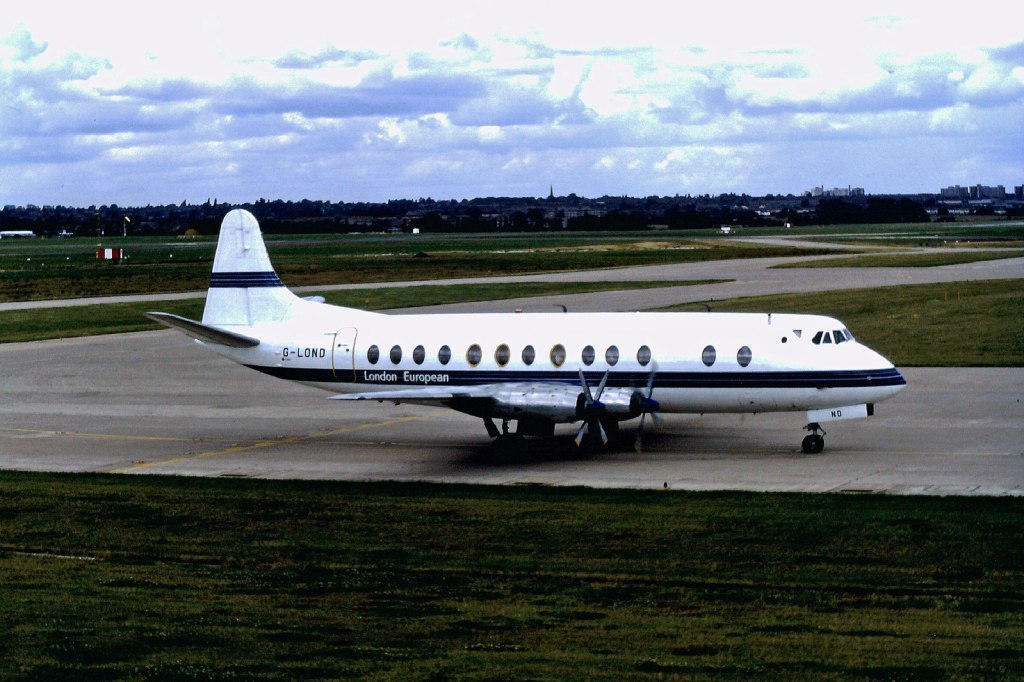
Approval was subsequently granted by the DfT for the twice-daily service, with convenient flight times which would appeal to the business passengers the airline was targeting.
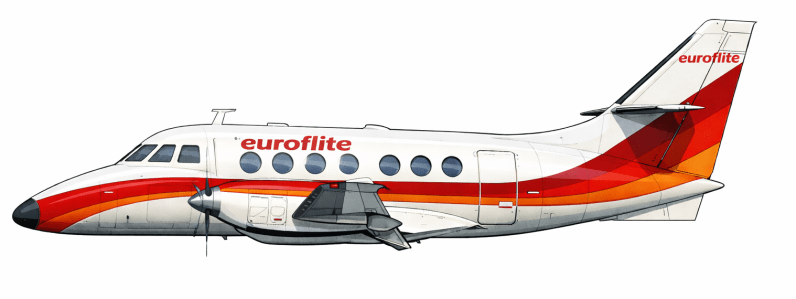
However, another Luton-based carrier, Euroflite (EO), immediately appealed the decision. Euroflite operated four British Aerospace BAe Jetstream 31s and also operated the Luton-Amsterdam and Luton-Brussels (BRU) routes. To quash the appeal, LEA subsequently purchased Euroflite for £300,000.
An additional five-times-per-week route to Brussels (BRU) soon followed, with the airline leasing a Short 330 (G-BITV) to provide additional capacity. Sadly, neither service lived up to expectations. Coupled with the considerable cost of purchasing Euroflite, London European was forced to suspend its operations on February 17, 1986, after authorities temporarily removed its operating licence.
Ryanair Rescue
But the struggling airline caught the eye of another burgeoning carrier, Ryanair (FR). The Irish airline commenced operations in 1985, and management wished to expand its network beyond Ireland and become a pan-European carrier. This, however, was before the European Open Skies agreement of 1992. Therefore, individual governments had their say on which airlines could operate what routes. The Irish government refused Ryanair’s request, wanting to protect the interests of its flag-carrier Aer Lingus (EI).
Seeing an opportunity with LEA, Ryanair bosses planned a takeover. They would then offer connections for passengers at Luton off its Dublin rotation and on to London European’s Amsterdam and Brussels routes.
Cathal Ryan, the son of Ryanair founder Tony Ryan and one of the airline’s first pilots, proposed a £630,000 rescue package for an 85% stake in LEA. Shareholders, desperate to see a return on their investment, immediately agreed. Mr Ryan would become the airline’s new Chairman.

Relaunch
Keeping its London European Airways name, the airline was relaunched in April 1987, and services to Brussels and Amsterdam recommenced on May 22, 1987, offering onward connections for Ryanair passengers on the Dublin-Luton operation. It later entered the jet age, introducing its first One-Eleven 500 (G-BNIH) in August 1987. The aircraft, named ‘The Spirit of Europe’ was a Romanian-built ROMBAC example, leased from TAROM Airlines (RO).
Moving to the One-Eleven was more than a fleet upgrade; it was a marketing ploy. A jet product carried a different passenger perception, particularly relevant on business routes, and offered higher speed and potentially improved aircraft utilisation.
As Ryanair expanded its operations, LEA losses continued to mount. Cathal Ryan decided to rebrand the carrier as Ryanair Europe on January 25, 1988. Further BAC One-Elevens were delivered, and five of the type would subsequently join the fleet, including the smaller -400 series (G-AZUK).
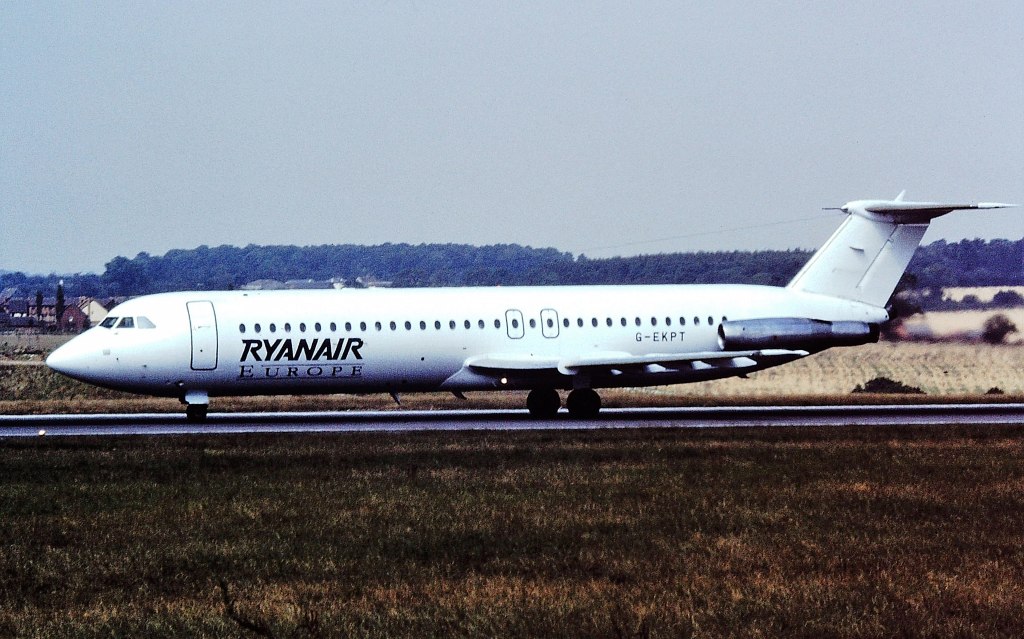
A year later, in January 1989, LEA ended all its scheduled flights and began operating charter services for Ryanair.
In 1991, the London European name had returned. LEA’s One-Elevens could be seen at destinations across the UK and Europe including – Alicante, Amsterdam, Belfast, Brussles, Deauville, Dublin, Düsseldorf, Edinburgh, Exeter, Faro, Glasgow, RAF Gütersloh, Ibiza, Isle of Man, Le Havre, Mahón, Málaga, Manchester, Marseille, Montpellier, Murcia, Naples, Newcastle, Oporto, Palma, Paris-Le Bourget, Reus, Stuttgart, Southend and Verona.
But at Ryanair, losses continued to mount. The airline announced in early 1991 that it would be transferring its London operations from Luton to Stansted (STN).
The move immediately cast doubt on the future of London European, and management decided to fully integrate the carrier into Ryanair’s mainline operation.
This subsequently led to the closure of London European Airways on May 1, 1991.

Fleet List
| Registration | Aircraft Type | Notes | |
| G-LOND | Vickers Viscount 800 | ||
| G-BIVT | Shorts 330 | Short term lease to add capacity. | |
| G-BNIH | ROMBAC 1-11-500 | ‘The Spirit of Europe’ | |
| G-AZUK | BAC 1-11-400 | To Ryanair Europe | |
| G-DJOS | BAC 1-11-500 | To Ryanair Europe | |
| G-EKPT | BAC 1-11-500 | To Ryanair Europe | |
| G-FLRU | BAC 1-11-500 | To Ryanair Europe | |
N.B. The author does not own the rights to any of the images included in this article unless otherwise stated.
Cover image credit: Ken Fielding/https://www.flickr.com/photos/kenfielding, CC BY-SA 3.0, via Wikimedia Commons
© Jet Back In Time by Lee Cross.
 Jet Back In Time
.jpg)
.jpg)
.jpg)
.jpg)